Tuesday, October 09, 2018
STYLE AND PART OF BUSINESS LETTER
- DEFINITION OF BUSINESS
LETTER
Business
letters is a formal communication from an organization to its customers, the
general public for their information, another Company or the Authorities. It is
often written in a standard format, and in formal language, compared to a
private letter between two people who are well known to each other. The
business letter will show things like the address and best way to communicate
with the business – by return letter , e-mail or telephone. In general, the
letter will be directed to a specific person and be about one topic. Sometimes,
the business letter will be looking for a response, but might be to give
important information about an up-coming change of address or telephone number.
The letter might give information about new developments – a new website;
launch of a new product. To allow the sender to handle any response more
efficiently, the business letter might contain key information such as an
internal reference from the sender or related to the product in question.
Letter
written in formal language, usually used when writing from one business
organization to another, or for correspondence between such organizations and
their customers, clients and other external parties. The overall style of
letter will depend on the relationship between the parties concerned. There are
many reasons to write a business letter. It could be to request direct
information or action from another party, to order supplies from a supplier, to
identify a mistake that was committed, to reply directly to a request, to
apologize for a wrong or simply to convey goodwill.
- TYPE OF
BUSINESS LETTER
The
term “business letters” refers to any written communication that begins with a
salutation, ends with a signature and whose contents are professional in
nature. Historically, business letters were sent via postal mail or courier,
although the internet is rapidly changing the way businesses communicate. There
are many standard types of business letters, and each of them has a specific
focus.
·
Sales Letters
Typical sales
letters start off with a very strong statement to capture the interest of the
reader. Since the purpose is to get the reader to do something, these letters
include strong calls to action, detail the benefit to the reader of taking the
action and include information to help the reader to act, such as including a
telephone number or website link.
·
Order Letters
Order letters
are sent by consumers or businesses to a manufacturer, retailer or wholesaler
to order goods or services. These letters must contain specific information
such as model number, name of the product, the quantity desired and expected
price. Payment is sometimes included with the letter.
·
Complaint Letters
The words and
tone you choose to use in a letter complaining to a business may be the
deciding factor on whether your complaint is satisfied. Be direct but tactful
and always use a professional tone if you want the company to listen to you.
·
Adjustment Letters
An adjustment
letter is normally sent in response to a claim or complaint. If the adjustment
is in the customer’s favor, begin the letter with that news. If not, keep your
tone factual and let the customer know that you understand the complaint.
·
Inquiry Letters
Inquiry letters
ask a question or elicit information from the recipient. When composing this
type of letter, keep it clear and succinct and list exactly what information
you need. Be sure to include your contact information so that it is easy for
the reader to respond.
·
Follow-Up Letters
Follow-up
letters are usually sent after some type of initial communication. This could
be a sales department thanking a customer for an order, a businessman reviewing
the outcome of a meeting or a job seeker inquiring about the status of his
application. In many cases, these letters are a combination thank-you note and
sales letter.
·
Letters of Recommendation
Prospective
employers often ask job applicants for letters of recommendation before they
hire them. This type of letter is usually from a previous employer or
professor, and it describes the sender’s relationship with and opinion of the
job seeker.
·
Acknowledgment Letters
Acknowledgment
letters act as simple receipts. Businesses send them to let others know that
they have received a prior communication, but action may or may not have taken
place.
·
Cover Letters
Cover letters
usually accompany a package, report or other merchandise. They are used to
describe what is enclosed, why it is being sent and what the recipient should
do with it, if there is any action that needs to be taken. These types of
letters are generally very short and succinct.
·
Letters of Resignation
When an
employee plans to leave his job, a letter of resignation is usually sent to his
immediate manager giving him notice and letting him know when the last day of
employment will be. In many cases, the employee also will detail his reason for
leaving the company.
- STYLES OF
BUSINESS LETTER
Business letter can be written with different styles, such as:
·
Full
Block.
Full block
style is a letter format in which all text is justified to the left margin. In
block letter style, standard punctuation is placed after salutations and in
other headings. Open punctuation, however, refers to a modification of style
where all nonessential punctuation is omitted. A few key factors will help you
understand block style format and the difference that open punctuation makes.

1.
Return
Address: If your
stationery has a letterhead, skip this. Otherwise, type your name, address and
optionally, phone number. These days, it’s common to also include an email
address. 2. Date: Type
the date of your letter two to six lines below the letterhead. Three are
standard. If there is no letterhead, type it where shown.
2.
Reference
Line: If the
recipient specifically requests information, such as a job reference or invoice
number, type it on one or two lines, immediately below the Date.
3.
Special
Mailing Notations: Type
in all uppercase characters, if appropriate.
4.
On-Arrival
Notations: Type in all
uppercase characters, if appropriate. You might want to include a notation on
private correspondence.
5.
Inside
Address: Type
the name and address of the person and/or company to whom you’re sending the
letter, three to eight lines below the last component you typed. Four lines are
standard.
6.
Attention
Line: Type the
name of the person to whom you’re sending the letter.
7.
Salutation: Type the recipient’s name here. Type
Mr. or Ms. [Last Name] to show respect, but don’t guess spelling or gender.
8.
Subject
Line: Type the
gist of your letter in all uppercase characters, either flush left or centered.
Be concise on one line.
9.
Body: Type two spaces between
sentences. Keep it brief and to the point.
10. Complimentary Close: What you type here depends on
the tone and degree of formality.
11. Signature Block: Leave four blank lines after the
Complimentary Close to sign your name. Sign your name exactly as you type it
below your signature. Title is optional depending on relevancy and degree of
formality.
12. Identification Initials: If someone typed the letter for you,
he or she would typically include three of your initials in all uppercase
characters, then two of his or hers in all lowercase characters.
13. Enclosure Notation: This line tells the reader to
look in the envelope for more. Type the singular for only one enclosure, plural
for more.
14. cc: Stands for courtesy copies (formerly carbon
copies). List the names of people to whom you distribute copies, in
alphabetical order.
·
Semi-block
Style
Semi-blok
fromat: in a format this text parallel left and all paragraphs in the letter is
indented. Format shape on this letter on letter head, date, complementary a
close, and signature being in a position flattened right. In the layout uneven
right, but can dibilangg flattened middle. Other parts on a letter as inside
address, subject, salutation, body of letter, and enclosure if terdapatnya attachment
letter,Being flattened on the left.
Sample Form
Letter Semi Block Style :
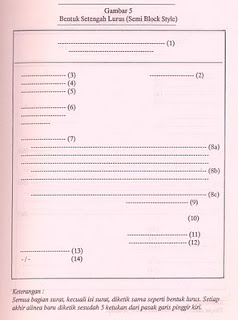
Description:
1.
Kop
Letter
2.
Date
of preparation of letters
3.
Letter
No.
4.
Attachment
5.
Case
6.
The
letter addressed
7.
a
word of salutation
8a.
Introduction letter
8b. Explanation
letter
8c. The cover letter
9. Greetings Closing
10. Name of office
11. Signature
12. Names to
approach
13. Copy
14. Attachment
page letter / initials

·
Simplified-Style
Simplified-style
business letters contain all the same elements as the full-block and semi-block
letters. Like the full-block format, the simplified format left-justifies every
line except for the company logo or letterhead. The date line is either
slightly right of center or flush with the center of the page. Letters written
in the simplified format have fewer internal sections, such as the body,
salutation and date line.
Using the
simplified style is the most useful at times when you don’t have a recipient’s
contact name. Because the simplified style does not require a salutation, you
don’t need the person’s name. The simplified format does away with unneeded
formality while maintaining a professional approach.

·
Hanging-Indented
Style
This very
useful style places the first words of each paragraph prominently on the page.
It is useful for letters that deal with a variety of different topics. However,
for normal business communications, this style is very rarely used. The first
line of the paragraph begins at the left-hand margin. And the other lines of
the same paragraph are indented three to four spaces. This is the reversal of
semi-indented style discussed in other page.
- PARTS OF
BUSINESS LETTER
1) The
Heading
The heading
contains the return address with the date on the last line. Sometimes it is
necessary to include a line before the date with a phone number, fax number, or
e-mail address. Often there is a line skipped between the address and the date.
It is not necessary to type a return address if you are using stationery with
the return address already imprinted, but you should always use a date. Make sure the heading is on the left margin.
Example:
Ms. Jane Doe
543 Washington St
Marquette, MI 49855
Tel:
Fax:
Email:
June 28, 2011
2) Recipient’s
Address
This is the
address you are sending your letter to. Be sure to make it as complete as
possible so it gets to its destination. Always include title names (such as
Dr.) if you know them. This is, like the other address, on the left margin. If
a standard 8 ½” x 11” paper is folded in thirds to fit in a standard 9”
business envelope, the inside address should appear through the window in the
envelope (if there is one). Be sure to skip a line after the heading and before
the recipient’s address, then skip another line after the inside address before
the greeting. For an example, see the end of this sheet for a sample letter.
3) The
Salutation
The salutation
(or greeting) in a business letter is always formal. It often begins with “Dear
{Person’s name}.” Once again, be sure to include the person’s title if you know
it (such as Ms., Mrs., Mr., or Dr). If
you’re unsure about the person’s title then just use their first name. For example,
you would use only the person’s first name if the person you are writing to is
“Jordan” and you’re not sure if he or she is male or female.
The salutation
always ends with a colon.
4) The
Body
The body is the
meat of your letter. For block and modified block letter formats, single space
and left justify each paragraph. Be sure to leave a blank line between each
paragraph, however, no matter the format. Be sure to also skip a line between
the salutation and the body, as well as the body and the close.
5) The
Complimentary Close
The
complimentary close is a short and polite remark that ends your letter. The
close begins at the same justification as your date and one line after the last
body paragraph. Capitalize the first word of your closing (Thank you) and leave
four lines for a signature between the close and the sender’s name. A comma
should follow the closing.
6) The
Signature Line
Skip at least
four lines after the close for your signature, and then type out the name to be
signed. This often includes a middle initial, although it is not required.
Women may put their title before had to show how they wish to be addressed
(Ms., Mrs., Miss).
The signature should
be in blue or black ink.
7) Enclosures
If you have any
enclosed documents, such as a resume, you can indicate this by typing
“Enclosures” one line below the listing. You also may include the name of each
document.
8) Format
and Font
Many
organizations have their own style for writing a business letter, but here are some common examples.
9) Block
The most common
layout for a business letter is called a block format. In this format, the
entire letter is justified to the left and single spaced except for a double
space between paragraphs.
10) Modified
Block
Modified block
is another popular type of business letter. The body of the letter and the
sender’s and recipient’s addresses are left justified and single spaced.
However, in this format, the date and closing are tabbed to the center point.
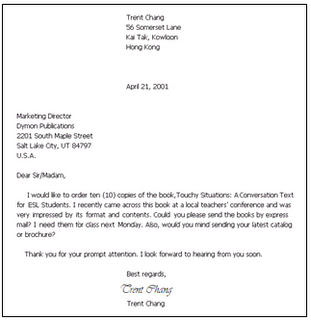
11) Semi-Block
The least used
style is called a semi-block. In it each paragraph is indented instead of left
justified.
12) Font
The standard
font for business letters is Times New Roman, size 12. However, fonts that are
clear to read such as Arial may be used.
Sunday, July 15, 2018
TUGAS STATISKA 2 (M-13)
Nama : Shoka Wennas Umara
Kelas : 2EB11
NPM : 27216028
1. Apakah sebab-sebab Autokorelasi
2. Faktor-faktor yang dapat menyebabkan
timbulnya masalah Autokolerasi!
3. Apakah yang dimaksud pengujian
Autokolerasi?
4. Dalam uji Durbin-Watson (DW-Test).
Terdapat beberapa asumsi penting yang harus dipatuhi, Apakah itu?
5. Coba jelaskan apa yang dimaksud
Asumsi Klasik!
6. Sebutkan apa saja asumsi-asumsi yang
ditetapkan!
7. Coba jelaskan mengapa tidak semua
asumsi perlu lakukan pengujian!
8. Jelaskan apa yang dimaksud dengan
Autokolerasi!
9. Jelaskan kenapa Autokolerasi timbul!
10. Bagaimana cara mendeteksi masalah
Autokolerasi
11. Apa konsekuensi dari adanya masalah
Autokolerasi dalam Model?
12. Jelaskan apa yang dimaksud dengan
Heteroskidastisitas!
13.
Jelaskan kenapa Heteroskedastisitas timbul!
14.
Bagaimana
cara mendeteksi masalah Heteroskedastisitas?
15.
Apa
konsekuensi dari adanya masalah Heteroskedastisitas dalam model?
16.
Jelaskan
apa yang dimaksud dengan Multikolinfaritas!
17.
Jelaskan
kenapa Multikolinfaritas timbul!
18.
Bagaimana
cara mendeteksi masalah Multikolinfaritas?
19.
Apa
konsekuensi dari adanya masalah Multikolinearitas dalam model?
20.
Jelaskan
apa yang dimaksud dengan Normalitas!
21.
Jelaskan
kenapa Normalitas timbul!
22.
Bagaimana
cara mendeteksi masalah Normalitas?
23.
Apa
konsekuensi dari adanya masalah Normalitas dalam Model?
24.
Bagaimana
cara menangani jika data ternyatab tidak Normal?
Jawaban
1.
Penyebab
autokorelasi adalah sebagai berikut:
•
Inersia
Salah
satu ciri menonjol dari sebagian deretan waktu ekonomi adalah inersia atau
kelembaman. Seperti telah dikenal dengan baik, deretan waktu seperti GNP.
Indeks Harga, produksi, kesempatan kerja dan pengangguran menunjukkan pola
siklus. Dalam kasus-kasus tersebut observasi yang berurutan nampaknya saling
bergantungan.
•
Bias
spesisifikasi mengeluarkan variabel yang relevan dari model
•
Bias
spesifikasi karena bentuk fungsional yang tidak benar
•
Fenomena
Cobweb
Penawaran
banyak komoditi pertanian mencerminkan apa yang disebut “Fenomena Cobweb” di
mana penawaran bereaksi terhadap harga dengan keterlambatannya satu periode
waktu karena keputusan penawaran memerlukan waktu untuk penawarannya (periode
persiapan) jadi pada awal musim tanam tahun ini pertanian dipengaruhi oleh
harga yang terjadi tahun lalu.
•
Manipulasi
data
Dalam
analisis empiris, data kasar seringkali “dimanipulasikan”. Sebagai contoh,
dalam regresi daretan waktu yang melibatkan data kuartalan, data seperti itu
biasanya diperoleh dari data bulanan dengan hanya marata-ratakan 3 observasi 3
bulanan. Pemerataan-rataan ini meratakan fluktuasi dalam data bulanan dan
dengan sendirinya mengakibatkan pola sistematis dalam error sehingga
menyababkan autokorelasi.
2.
Terdapat
banyak faktor-faktor yang dapat menyebabkan timbulnya masalah autokorelasi,
beberap faktor tersebut antara lain:
•
Kesalahan
dalam pembentukan model, artinya, model yang digunakan untuk menganalisis
regresi tidak didukung oleh teori-teori yang relevan dan mendukung.
•
Tidak
memasukkan variabel yang penting. Variabel penting yang dimaksudkan di sini
adalah variabel yang diperkirakan signifikan mempengaruhi variabel Y.
•
Manipulasi
data. Misalnya dalam penelitian kita ingin menggunakan data bulanan, namun data
tersebut tidak tersedia. Kemudian kita mencoba menggunakan triwulanan yang
tersedia, untuk dijadikan data bulanan melalui cara interpolasi atau
ekstrapolasi.
•
Menggunakan
data yang tidak empiris. Jika data semacam ini digunakan, terkesan bahwa data
tersebut tidak didukung oleh realita.
3.
Uji Autokorelasi adalah sebuah analisis
statistik yang dilakukan untuk mengetahui adakah korelasi variabel yang ada di
dalam model prediksi dengan perubahan waktu.
4.
Dalam
DW test ini terdapat beberapa asumsi penting yang harus dipatuhi, yaitu:
•
Terdapat
intercept dalam model regresi.
•
Variabel
penjelasnya tidak random ( nonstochastics ).
•
Tidak
ada unsur lag dari variabel dependen di dalam model.
•
Tidak
ada data yang hilang.
•
υ
= ρυ + ε t t − 1 t
5.
Uji
asumsi klasik adalah persyaratan statistik yang harus dipenuhi pada
analisis regresi linear berganda yang berbasis ordinary least square (OLS).
Jadi analisis regresi yang tidak berdasarkan OLS tidak memerlukan persyaratan
asumsi klasik, misalnya regresi logistik atau regresi ordinal. Demikian juga
tidak semua uji asumsi klasik harus dilakukan pada analisis regresi linear,
misalnya uji multikolinearitas tidak dilakukan pada analisis regresi linear sederhana
dan uji autokorelasi tidak perlu diterapkan pada data cross sectional.
6.
Asumsi
1 : linear regresion Model. Model regresi merupakan hubungan linear dalam
parameter.
Asumsi 2 : Nilai X adalah tetap
dalam sampling yang diulang – ulang
Asumsi 3 : Variabel penggangu e
memiliki rata –rata nol
Asumsi 4 : Homoskedastisitas atau
variabel penggangu e memiliki variance yang sama sepanjang observasi dari
berbagai nilai X.
Asumsi 5 : Tidak ada autokorelasi
antara variabel e pada setiap nilai Xi dan ji
Asumsi 6 : Variabel X dan
disturbance e tidak berkorelasi.
Asumsi 7 : Jumlah observasi /
besar sample (n) harus lebih besar dari jumlah parameter yang diestimasi.
Asumsi 8 : Variabel X harus
memiliki variabilitas.
Asumsi 9 : Model regresi secara
benar telah terspesifikasi.
Asumsi 10 : Tidak ada
multikolinearitas antara variabel penjelas
7.
Karena
tidak semua data dapat diperlakukan dengan regresi, Jika data yang diregresi
tidak memenuhi asumsi-asumsi yang telah disebutkan (asumsi klasik), maka
regresi yang diterapkan akan menghasilkan estimasi yang bias.
8.
Uji Autokorelasi adalah sebuah analisis
statistik yang dilakukan untuk mengetahui adakah korelasi variabel yang ada di
dalam model prediksi dengan perubahan waktu. Oleh karena itu, apabila asumsi
autokorelasi terjadi pada sebuah model prediksi, maka nilai disturbance tidak
lagi berpasangan secara bebas, melainkan berpasangan secara autokorelasi.
9.
Masalah
autokorelasi sering timbul pada data runtut waktu (time series). Penyebab utama
autokorelasi adalah kesalahan spesifikasi, misalnya terabaikannya suatu
variabel penting atau bentuk fungsi yang tidak tepat. Berikut beberapa penyebab
munculnya autokorelasi dalam analisis regresi:
•
Adanya
kelembaman (inertia), yaitu data observasi pada periode sebelumnya dan periode
sekarang, kemungkinan besar akan mengandung saling ketergantungan
(independence).
•
Bisa
spesifikasi model kasus yang tidak dimasukkan. Hal ini disebabkan oleh tidak
dimasukkannya variabel yang menurut teori sangat penting peranannya dalam
menjelaskan variabel terikat (tak bebas). Bila hal ini terjadi, unsur
pengganggu (error term) akan merefleksikan suatu pola yang sistematis antara
sesama unsur pengganggu sehingga terjadi situasi otokorelasi diantara unsur
pengganggu.
•
Adanya
fenomena laba-laba (cobweb phenomenon), yaitu data yang diperoleh saat ini (X₁) dipengaruhi oleh data
sebelumnya (X₀) sehingga data setelah saat ini/data berikutnya(X₂) memiliki kecenderungan
dipengaruhi oleh data pendahulunya (X₀) sehingga data X₂ memiliki potensi lebih
rendah dari data X₁. Akibatnya error term tidak lagi bersifat acak
(random), tetapi mengikuti pola sarang laba-laba.
•
Manipulasi
data (manipulation of data). Dalam analisis empiris terutama data time series
sering kali terjadi manipulasi data, hal ini terjadi data yang diinginkan tidak
tersedia. Adanya interpolasi atau manipulasi data jelas akan menimbulkan suatu
pola fluktuasi yang tersembunyi yng mengakibatkan munculnya pola sistematis
dalam unsur penggangu dan akhirnya akan menimbulkan masalah autokorelasi.
•
Adanya
kelembaman waktu (time lags). Dalam regresi data time series, pengaruh
psikologis, teknis dan kelembagaan. Jika unsur lag diabaikan dari suatu mdel
yang dibentuk, maka error term yang dihasilkan akan mencerminkan pola
sistematis sebagai akibat pengaruh variabel terikat pada periode sebelumnya
atau periode sekarang.
10. Cara mendeteksi
autokeralasi dengan metode grafik, uji Durbin Watson, uji Run, dan uji
Breusch-Godfrey (BG)/Langrange Multiplier (LM).
11. Konsekuensinya antara
lain:
•
Estimator
yang dihasilkan masih unbiased, konsisten, dan asymptotical normally
distributed. Tetapi tidak lagi efisien->varians tidak minimum (tidak BLUE).
•
Estimasi
standard error dan varian koefisien regresi yang didapat akan ‘underestimate’.
•
Pemerikasaan
terhadap residualnya akan menemui permasalahan.
•
Autokorelasi
yang kuat dapat pula menyebabkan dua variabel yang tidak berhubungan menjadi
berhubungan. Biasa disebut spourious regression. Hal ini terlihat dari R2.
12. Uji
Heteroskedastisitas adalah
uji yang menilai apakah ada ketidaksamaan varian dari residual untuk semua
pengamatan pada model regresi linear. Uji ini merupakan salah satu dari uji
asumsi klasik yang harus dilakukan pada regresi linear. Apabila asumsi
heteroskedastisitas tidak terpenuhi, maka model regresi dinyatakan tidak valid
sebagai alat peramalan.
13. Heteroskedastisitas timbul
apabila kesalahan atau residual dari model yang diamati tidak memiliki varians
yang konstan dari satu observasi ke observasi lainnya (Kuncoro, 2001: 112). Padahal
rumus regresi diperoleh dengan asumsi bahwa variabel pengganggu (error) atau e,
diasumsikan memiliki variabel yang konstan (rentangan e kurang lebih sama).
Apabila terjadi varian e tidak konstan, maka kondisi tersebut dikatakan tidak
homoskedastik atau mengalamiheteroskedastisitas (Setiaji, 2004: 17).
14. Untuk mendeteksi ada
tidaknya heteroskedastisitas, dapat dilakukan dengan berbagai cara seperti uji
grafik, uji Park, Uji Glejser, uji Spearman’s Rank Correlation, dan uji Whyte
menggunakan Lagrange Multiplier (Setiaji, 2004: 18)21. Pengujian
heteroskedastisitas menggunakan uji grafik, dapat dilakukan dengan
membandingkan sebaran antara nilai prediksi variabel terikat dengan
residualnya, yang output pendeteksiannya akan tertera berupa sebaran data padascatter
plot. Pengujian heteroskedastisitas menggunakan uji Arch, dilakukan dengan cara
melakukan regresi atas residual, dengan model yang dapat dituliskan e2 = a +
By2 + u. Dari hasil regresi tersebut dihitung nilai R2. Nilai R2 tadi dikalikan
dengan jumlah sampel (R2 x N). Hasil perkalian ini kemudian dibandingkan dengan
nilai chi-square (x2) pada derajat kesalahan tertentu.
15. Analisis regresi linier
yang berupa variance residual yang sama, menunjukkan bahwa standar error (Sb)
masing-masing observasi tidak mengalami perubahan, sehingga Sb nya tidak
bias., Jika asumsi ini tidak
terpenuhi, sehinggavariance residualnya berubah-ubah sesuai perubahan
observasi, maka akan mengakibatkan nilai Sb yang diperoleh dari hasil regresi
akan menjadi bias. Karena nilai t dihasilkan dari hasil bagi antara b dengan
Sb. Jika nilai Sb mengecil, maka nilai t cenderung membesar.Nilai t yang
seharusnya signifikan, bisa jadi ditunjukkan menjadi tidak signifikan.
Ketidakmenentuan dari Sb ini dapat menjadikan hasil riset yang mengacaukan.
16. Multikolinieritas
adalah
suatu keadaan dimana terjadi korelasi linear yang ”perfect” atau eksak di
antara variabel penjelas yang dimasukkan ke dalam model. Tingkat kekuatan
hubungan antar variabel penjelas dapat ditrikotomikan lemah, tidak berkolinear,
dan sempurna. Tingkat kolinear dikatakan lemah apabila masing-masing variabel
penjelas hanya mempunyai sedikit sifat-sifat yang sama.
17. a. Kesalahan teoritis dalam pembentukan model
fungsi regresi yang dipergunakan/ memasukkan variabel bebas yang hampir sama,
bahkan sama.
b.
Terlampau
kecilnya jumlah pengamatan yang akan dianalisis dengan model regresi
18. Ada beberapa metode
deteksi multikolinearitas, antara lain:
a.
Kolinearitas
seringkali diduga jika R2 cukup tinggi (antara 0,7-1) dan jika koefisien korelasi
sederhana (korelasi derajat nol) juga tinggi, tetapi tak satu pun/ sedikit
sekali koefisien regresi parsial yang signifikan secara individu. Di pihak
lain, uji F menolak H0 yang mengatakan bahwa secara stimulan seluruh koefisien
regresi parsialnya adalah nol.
b.
Meskipun
korelasi derajat nol yang tinggi mungkin mengusulkan kolinearitas, tidak perlu
bahwa mereka tinggi berarti mempunyai kolinearitas dalam kasus spesifik. Untuk
meletakkan persoalan agar secara teknik, korelasi derajat nol yang tinggi merupakan
kondisi yang cukup tapi tidak perlau adanya kolinearitas karena hal ini dapat
terjadi meskipun melalui korelasi derajat nol atau sederhana relaif rendah.
c.
Untuk
mengetahui ada tidaknya kolinearitas ganda dalam model regresi linear berganda,
tidak hanya melihat koefisien korelasi sederhana, tapi juga koefisien korelasi
parsial.
d.
Karena
multikolinearitas timbul karena satu atau lebih variabel yang menjelaskan
merupakan kombinasi linear yang pasti atau mendekati pasti dari variabel yang
menjelaskan lainnya, satu cara untuk mengetahui variabel X yang mana
berhubungan dengan variabel X lainnya adalah dengan meregresi tiap Xi atas sisa
variabel X dan menghitung R2 yang cocok, yang bisa disebut .
19. a. Walaupun bersifat
BLUE, estimator OLS yang didapatkan memiliki varians dan kovarians yang besar,
sehingga estimasi yang tepat sulit dilakukan.
b.
Rentang
kepercayaan (confidence interval) menjadi besar.
c.
Uji
t untuk satu atau beberapa koefisien regresi cenderung untuk tidak signifikan.
d.
Walaupun
banyak koefisien yang tidak signifikan (dalam uji-t), akan tetapi nilai
koefisien determinasi (R2) biasanya sangat tinggi.
e.
Estimator
OLS dan standart errornya menjadi sangat sensitif dengan adanya perubahan kecil
pada data.
20. Uji
Normalitas adalah sebuah uji yang dilakukan dengan tujuan untuk menilai
sebaran data pada sebuah kelompok data atau variabel, apakah sebaran data
tersebut berdistribusi normal ataukah tidak. Uji Normalitas berguna untuk
menentukan data yang telah dikumpulkan berdistribusi normal atau diambil dari
populasi normal.
21. Sebenarnya istilah
“normalitas” dalam statistik itu biasa digunakan untuk menjelaskan jenis
distribusi dari sebuah data. Suatu data memiliki kecenderungan terhadap suatu
jenis distribusi, seperti : distribusi binomial, hypergeometri, poisson, normal,
weilbul, dll. Jenis distribusi data dapat ditentukan dari karakteristik data
itu sendiri, dapat pula dilakukan pengujian apakah data tersebut memiliki
kecenderungan terhadap suatu distribusi (salah satunya distribusi normal).
22. Untuk masalah menguji
sebuah data terdistribusi normal atau tidak dapat menggunakan beberapa cara
(uji). Ada Uji Kolmogorov Smirnov (KS test), Jaque Berra Test, Anderson Darling
Test, dll. Uji normalitas (sebutan untuk
menguji apakah sebuah data terdistribusi normal atau tidak) biasanya dilakukan
sebagai persyaratan atas sebuah metode tertentu, misalnya dalam regresi linier
sebagai salah satu persyaratan asumsi klasik, penentuan apakah menggunakan
statistik parametrik nonparametrik, dll.
23. Konsekuensi dari adanya
masalah normalitas adalah pengujian normalitas ini berdamoak pada nilai t dan F
karena pengujian terthadap keduangan diturunkan dari asumsi bahwa data Y atau e
berdistribusi normal.
24. Cara menangani jika data
tersebut ternyata tidak normal diperlukan upaya untuk mengatasi seperti
memotong data out liers, memperbesar sampel atau melakukan transformasi data.
Gunadarma University
